Innovation continues to shape the way Oil and Gas resources are developed across the United States. One notable trend in recent years has been the increasing length of horizontal well laterals, particularly in major producing regions such as the Permian Basin.
According to the U.S. Energy Information Administration (EIA), the average lateral length of a new horizontal well in the Permian region increased 77% over the past decade, rising from 6,149 feet in 2015 to 10,867 feet in 2025.
This shift toward longer horizontal laterals demonstrates how advances in drilling and completion techniques continue to influence domestic Oil and Gas development.
Horizontal drilling allows an Oil and Gas well to transition from a vertical path to a horizontal path once it reaches the targeted underground formation. The horizontal portion of the well is commonly referred to as the lateral.
Rather than accessing the formation primarily at a single vertical location, a horizontal lateral can extend thousands of feet through hydrocarbon-bearing rock.
The length of that lateral determines how much of the targeted formation a well can potentially contact. As drilling technology and operational techniques have advanced, Operators have increasingly developed longer laterals.
Data highlighted by the EIA shows how significantly drilling practices in the Permian region have changed.
In 2015, horizontal wells with laterals shorter than 5,000 feet represented 43% of completed wells in the region. By 2025, those shorter laterals represented just 4%.
At the same time, longer wells have become increasingly common. Mid-length laterals measuring between 5,000 and 15,000 feet accounted for 81% of new horizontal well completions in 2025.
An additional category has also emerged: super-laterals.
These horizontal wells extend more than 15,000 feet, or nearly three miles. According to the EIA, super-laterals were virtually nonexistent in the Permian before 2020 but accounted for 15% of new well completions in the region by 2025.
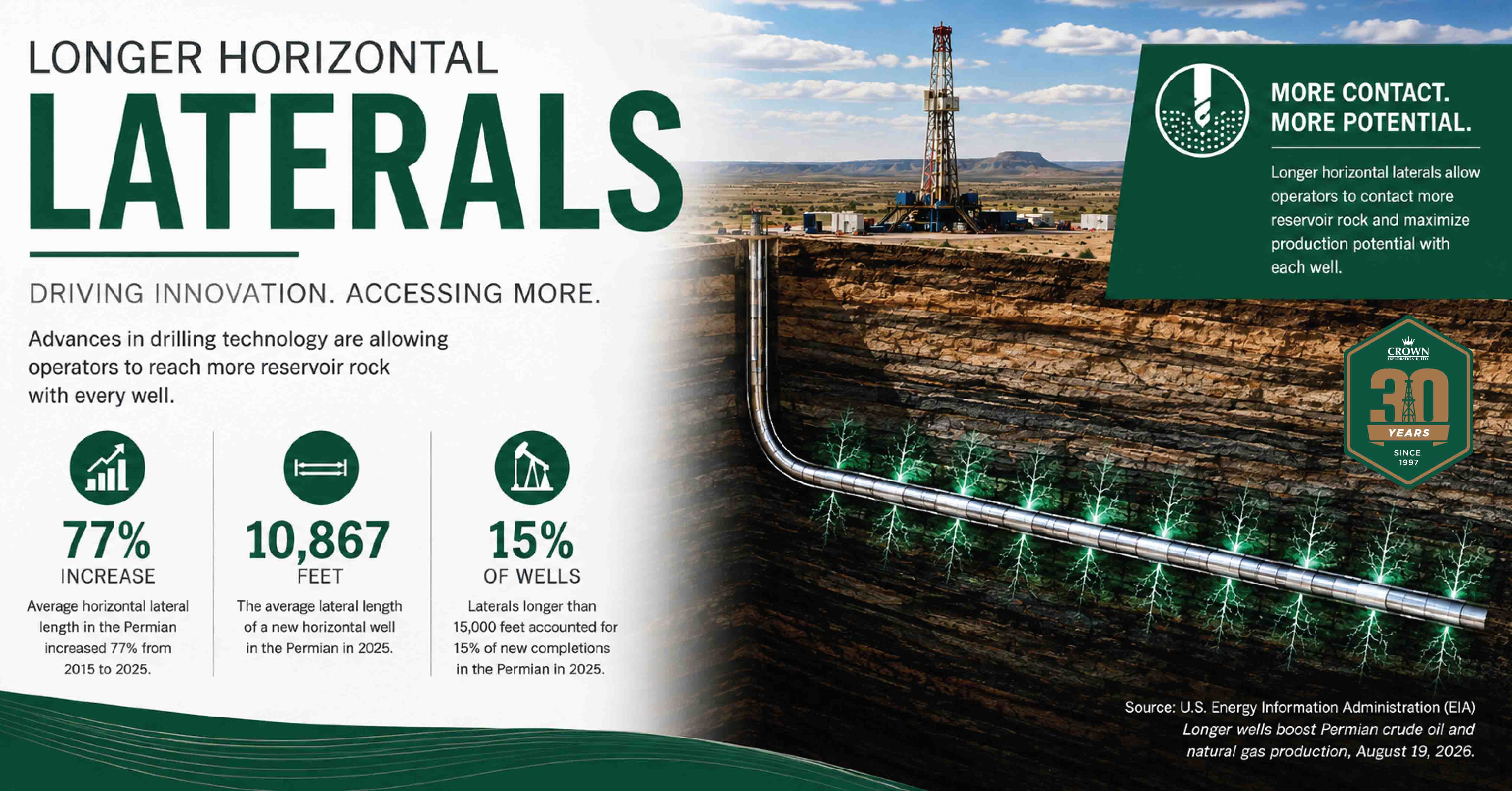
One of the primary advantages of a longer horizontal lateral is the ability to contact more reservoir rock with a single well.
The EIA notes that longer laterals can help Operators maximize production while keeping well counts lower, and therefore certain overhead costs, down.
Instead of relying solely on drilling additional wells to access more of a formation, Operators can extend the horizontal portion of a well farther through the targeted reservoir.
The trend illustrates an important characteristic of today's Oil and Gas industry: production growth does not depend only on drilling more wells. Improvements in how wells are designed, drilled, and completed can also contribute to greater operational productivity.
The continued adoption of longer horizontal laterals is one example of how technological advancement has transformed U.S. energy development.
In the Permian region, the number of new horizontal well completions has remained relatively stable at approximately 6,000 per year since 2022, according to the EIA. At the same time, the region has experienced significant growth in hydrocarbon production.
Longer laterals are one of several factors contributing to the industry's ability to develop Oil and Gas resources more efficiently.
For Accredited Investors evaluating Oil and Gas opportunities, understanding developments such as horizontal drilling, lateral length, well design, geology, and completion techniques can provide useful context for how modern energy projects are developed.
No single factor determines the potential performance of an Oil and Gas project. However, the evolution of horizontal lateral lengths demonstrates how technology and operational experience continue to change the way domestic energy resources are accessed.
Horizontal drilling has already transformed U.S. Oil and Gas production, and the increasing use of longer laterals represents another stage in that evolution.
As Operators continue refining drilling and completion strategies, advances in well design may provide additional opportunities to access domestic Oil and Gas resources while improving operational efficiency.
For Accredited Investors considering participation in Oil and Gas projects, understanding the technology behind modern drilling can be an important part of evaluating the broader opportunity.
Crown Exploration has three decades of experience in the Oil and Gas industry and provides Accredited Investors with opportunities to participate in domestic Oil and Gas projects.